
California is on the verge of expanding the nanny-welfare state in major ways. Would you believe zero-price breakfasts and lunches for every “TK-12” student in public schools? How about “community wellness and student health hubs on over 1,000 school campuses”? And don’t forget “medically tailored meals”. And, of course, the package includes assistance for the elderly (one of the wealthiest population segments in the state).
All this and much more is part of the Subcommittee Report 2021-22 Budget (June 1, 2021). Co-authored by Phil Ting (chair, Assembly Budget Committee) and Nancy Skinner (chair, Committee on Budget and Fiscal Review), the budget is a grab-bag of enough welfare programs to give any Democrat a solid wet dream – regardless of gender.
Let’s start with food for students and their families. The cost of the basic program is projected to be $650 million per year starting in the 2022-23 fiscal year. With a forecast TK-12 public school enrollment of 6,002,523, per-student spending will be $108.29. (For those unfamiliar with the ever-changing acronyms used by education professionals, TK stands for transitional kindergarten.)
California requires 180 days of instruction a year. The proposal to expand meals seems to imply that the new offerings will cover more days and more family members. Let’s ignore that. The state seems to believe they can feed kids breakfast and lunch for $0.60 per student per school day. I realize there are vast economies of scale in food preparation, this cost makes me wonder what the kids will be eating. I’m certain the meals will meet basic nutrition requirements. Whether kids will actually eat them is another question entirely.
But never fear. The initiative includes $200 million to train school food service workers to “promote healthier and more nutritious meals, and grants for kitchen infrastructure upgrades.” There’s another $257 million to Increase school meals program funding “for payments to child nutrition program operators to offset pandemic program costs.” Both of these are budgeted as one-time expenditures.
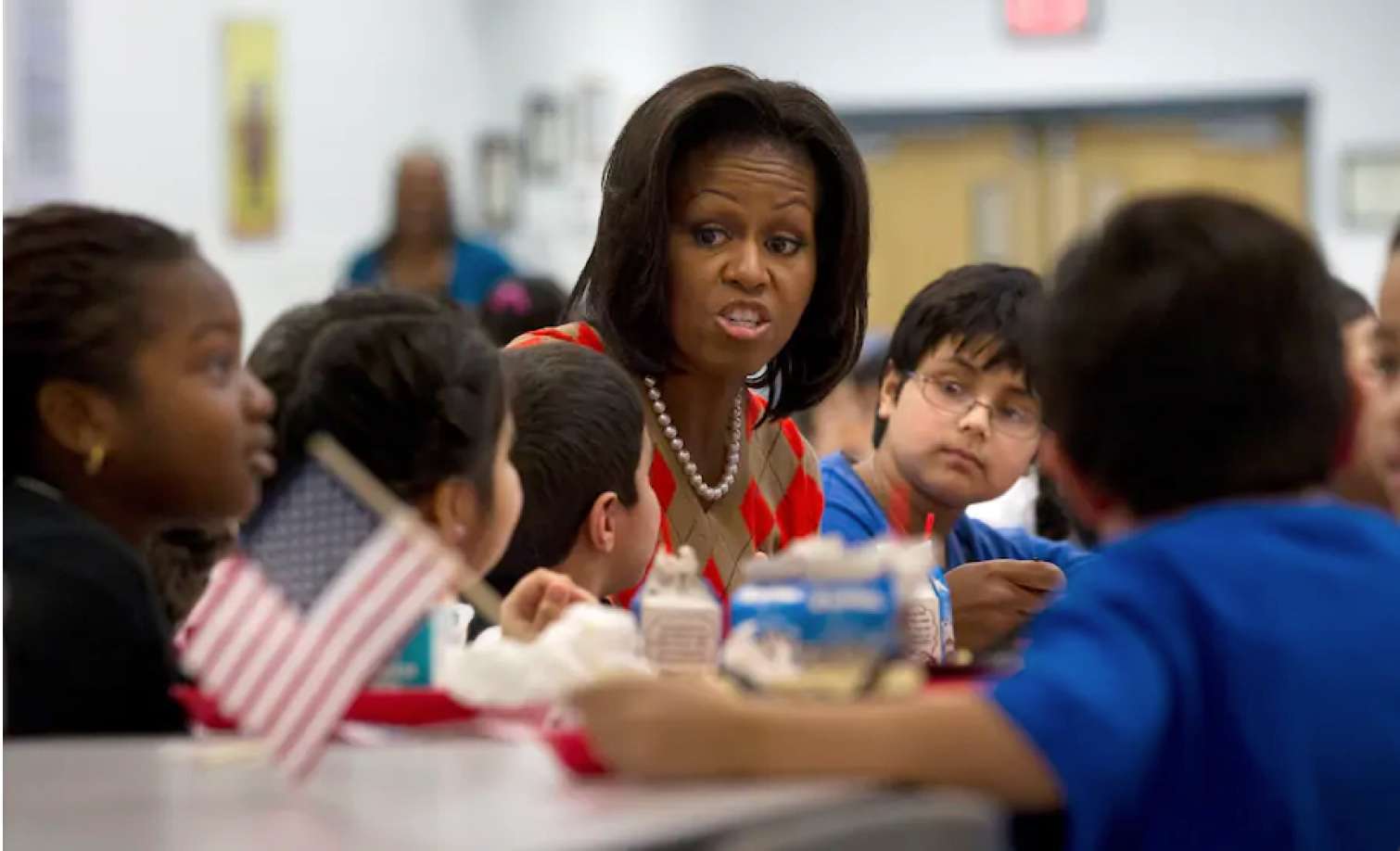
Michelle Obama Lunch Program Fail
Remember First Lady Michelle Obama’s school lunch initiative? The Washington Post (November 25. 2014)[1] had this headline: “School kids are blaming Michelle Obama for their ‘gross’ school lunches.” You can put anything you want in front of the kids, but you can’t make them eat it.
But those programs are peanuts compared to some other education proposals. Combined, these initiatives will cost $8 billion in one-time spending plus $1 billion a year in recurring costs. These initiatives are:
- Universal Transitional Kindergarten (phasing in expanded age eligibility to full implementation in 2025-26),
- Community Schools (provides $2 billion to launch a statewide initiative to build accessible community wellness and student health hubs on over 1,000 school campuses), and
- Expanded Learning (expands after school and summer options for free after school and summer options for all low-income students through the 2022-23 school year).
Where to begin? Universal transitional kindergarten, breakfast and lunch (at the minimum), health centers open to the public, and a variety of after-school programs. The state has apparently decided it can do a better job raising your children than you. The nanny state is expanding its reach massively.
- Washington Post, November 25, 2014. Available at https://www.washingtonpost.com/news/wonk/wp/2014/11/24/students-are-blaming-michelle-obama-for-their-gross-school-lunches/. Accessed June 14, 2021. ↑